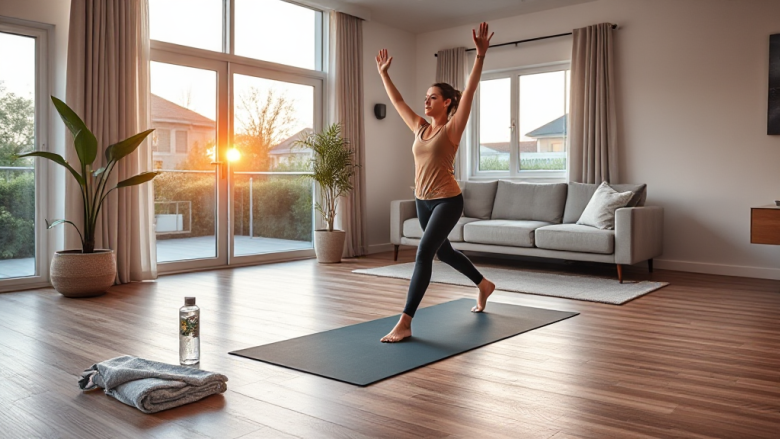
Low impact doesn’t mean low effort. That’s the first thing worth clearing up, because plenty of people hear the phrase and picture a gentle stretch session that barely raises a pulse. In reality, low impact cardio workouts at home can push your heart rate every bit as hard as a run or a jump-heavy class. The difference is simply that one foot stays on the floor. No bouncing, no pounding, no thudding on the ceiling of the flat below you.
If your knees complain after a HIIT video, if your living room is barely wider than a yoga mat, or if you can hear your neighbour’s television through the floor and assume they can hear you too, this is for you. Below are three complete sessions — beginner, intermediate and advanced — each with a warm-up, a main set and a cool-down, plus swaps for when something doesn’t feel right.
Why Low Impact Cardio Works Just as Hard
Impact is the force your joints absorb when you land. Jumping jacks, burpees and running all produce a lot of it. Removing that landing doesn’t remove the work; it just redirects it. A fast march, a squat with a pulse, a step-touch with a strong arm drive — these keep the large muscles of the legs and glutes contracting continuously, and continuous large-muscle work is exactly what drives heart rate up.
The trick is intensity, not impact. If a movement feels easy, you’re probably not getting much from it. You want to be breathing harder than normal, able to speak a short sentence but not hold a conversation. That’s the sweet spot for cardiovascular training. You can reach it sitting down, standing up, or stepping side to side. What you can’t do is reach it while moving at half effort and checking your phone.
There’s a practical bonus too. Low impact sessions are usually quiet. No jumping means no complaints, which means you can actually train at 6am or 10pm without a guilty conscience. For anyone in a flat, a shared house or a creaky old building, that alone is worth the trade.
What You Need Before You Start
Very little. A clear patch of floor roughly the size of a yoga mat, something to drink, and enough headroom to raise your arms. Trainers are helpful but not essential if you’re on carpet. If you have hard floors, a towel or mat under your feet reduces slipping and takes the edge off repeated stepping.
Set a timer you can see or hear. Most phones will do. You’ll be working in short blocks, and glancing at a screen every few seconds breaks your rhythm, so a timer that beeps is better than one you have to watch.
One more thing: check with a doctor first if you have a heart condition, uncontrolled blood pressure, a recent injury or you’re pregnant. That’s not a box-ticking line. It’s the difference between a sensible session and an avoidable problem.
Session One: Beginner (20 Minutes)
This is the starting point. It’s designed for someone who hasn’t trained in a while, or who finds most home workouts leave their knees sore the next day. Move at a pace you could just about hold a broken conversation through.
Warm-up — 4 minutes. March on the spot for one minute, then add arm swings forward and back for another minute. Spend the next two minutes doing gentle step-touches side to side, gradually widening the step. You’re aiming to feel warm, not tired.
Main set — 12 minutes. Work for 40 seconds, rest for 20, and repeat each of the following three times: standing knee lifts at a brisk march, step-touch with a reach overhead, and a slow bodyweight squat with a two-second pause at the top. That’s nine rounds in total, roughly twelve minutes.
Cool-down — 4 minutes. Walk on the spot slowly for two minutes, letting your breathing settle, then hold a gentle calf stretch and a standing quad stretch for about thirty seconds each side.
If the knee lifts feel like too much, swap them for a seated march — sit on the edge of a chair and drive the knees up alternately. You’ll still raise your heart rate, and your joints get a rest.
Session Two: Intermediate (25 Minutes)
Once the beginner session stops making you breathe hard, move here. The structure is similar but the work periods are longer and the movements ask more of your legs.
Warm-up — 5 minutes. March for a minute, then step-touch for a minute. Add two minutes of arm circles and shoulder rolls while continuing to step, then finish with a minute of slow, controlled squats to wake up your hips.
Main set — 15 minutes. Work for 45 seconds, rest for 15. Cycle through four movements three times: fast step-touch with a strong arm drive, alternating reverse lunges, squat to a calf raise, and a standing cross-body punch. Keep the transitions quick — the rest is short on purpose.
Cool-down — 5 minutes. Slow march for two minutes, then stretch your hamstrings, hip flexors and chest. Hold each for around thirty seconds and breathe out as you settle into it.
If reverse lunges bother your knees, swap them for a step-back that doesn’t lower as far, or replace them entirely with standing leg curls — heel to bottom, one leg at a time. Same muscles, less load through the joint.
Session Three: Advanced (30 Minutes)
This one is for someone with a decent base who wants a proper sweat without a single jump. It’s demanding. Expect to be breathing hard by the halfway mark.
Warm-up — 5 minutes. Build gradually: march, step-touch, then add squats and arm drives. By the last minute you should feel ready to work, not still warming up.
Main set — 20 minutes. Work for 50 seconds, rest for 10. Run through five movements four times: fast squat pulses, alternating skater steps (staying low, no jump), standing mountain climbers with slow controlled knees, a low-impact burpee (step back, step forward, stand tall), and a fast standing march with high arms. Twenty rounds, twenty minutes.
Cool-down — 5 minutes. Walk it off for two minutes, then work through calf, hamstring, quad and hip stretches. Give yourself the full five minutes here. You’ve earned it, and it helps tomorrow feel less stiff.
If the low-impact burpee feels awkward, break it into two separate moves: a step-back lunge and a standing reach. It looks less tidy but trains the same pattern.
How to Make It Harder Without Adding Impact
This is where most people get stuck. They get fitter, the session stops challenging them, and they assume the answer is jumping. It isn’t. There are several levers you can pull first.
Increase the work period and shorten the rest. Going from 40 seconds on and 20 off to 50 on and 10 off raises the intensity considerably with no extra load on your joints. Slow the movements down and add a pause at the hardest point — a three-second squat descent with a two-second hold at the bottom will humble most people. Add range: step wider, reach higher, sink deeper. Add resistance with a backpack holding a couple of books, or a filled water bottle in each hand. Or simply reduce your rest between rounds from fifteen seconds to five.
Any one of those changes will make a session harder. Combine two and you’ll wonder why you ever thought low impact was easy.
Common Questions About Low Impact Cardio at Home
How often should I do these sessions?
Three or four times a week is a sensible target for general cardiovascular health, with at least one rest day between harder sessions. If you’re new to training, start with the beginner session twice a week and add a third once it feels manageable.
Can I do low impact cardio every day?
You can, provided you vary the intensity. Alternating a harder session with a gentler one, or splitting the week between cardio and light strength work, gives your body time to recover. Doing the advanced session daily is a fast route to sore knees and stalled progress.
Will low impact cardio help me lose weight?
It burns calories and improves cardiovascular fitness, which supports weight management alongside sensible eating. It won’t out-train a poor diet, but it’s a genuinely useful part of the picture — and it’s sustainable, which matters more than intensity in the long run.
Is it still effective if I never jump?
Yes. Heart rate responds to effort, not to whether your feet leave the floor. Plenty of people train for years without jumping and maintain excellent fitness. The only requirement is that you push hard enough during the work periods.
Start with the beginner session this week. Give it three honest attempts before deciding whether it’s too easy, then move up. The whole point of low impact cardio workouts at home is that they fit around your life — your joints, your space, your neighbours — without asking you to compromise on effort.